Saturday, April 4, 2015

Transitions

In yoga, the term "transitions" usually refers to how you get from one pose to the next.  As a yoga teacher, you want this process to be smooth and controlled; you want to be able to instruct your students to move fluidly from one pose to another.   This requires their attention, focus, and strength...as they move forward in their yoga practice, it becomes easier because of gained flexibility, and that pointed concentration is what enables students to find in their yoga practice solace from everyday frustrations and stress.

When you think about it, however, life itself is full of transitions, and those same mindfulness techniques of your yoga practice can hopefully help you move from one point to the next with a minimum of frustrations and/or stress.  

This week, the yoga studio where I have been teaching for almost two years will be shuttering it's storefront.  In fact, this morning, I taught my final class in that space.  It was a great class to teach - a full-house, if you will - with students of all ages and experience.  Some folks were part of my "regular corp": faithful attendees to the 8am Saturday class, some folks were using up their class cards, and others were just dropping in.  We worked on building some heat with Sun Salutations, then we transitioned into some standing poses, setting the foundation for each, and then incorporated that into a smooth mini-flow.  Students took what they learned and experienced from each pose and made a smooth transition from one to the next.  Judging from the smiles and relaxed looks after Savasana, I think it was all pretty good.

Now, as I move forward, I am unsure of what is next, and I am okay with that.  Perhaps the opportunity will present itself for me to continue what I do in a new space.  Perhaps my role as a yoga teacher will transition into that of a student for a little while.  Whatever the path, I hope to be guided by strength, focus, and flexibility!

Stay tuned, and know that the light within me salutes the light within you.  We are all fibres of the same fabric, and our strength and resiliency reinforces one another's ability to transition.

Wednesday, August 27, 2014

Filling the Space...

Last Saturday, in my Yoga Foundations class, we paid tribute to yogacharya BKS Iyengar, who passed away on August 20th. Iyengar was a leader in the world of yoga, mainly responsible for bringing yoga "to the west".  He credited the practice with helping him to overcome Malaria, Tuberculosis, and Typhoid fever as a child.  Since he lived to the age of 95, I'd say he was on to something!

We followed the beginner's sequence outlined in Iyengar's book, "Light on Yoga":  Tadasana, Vrksasana, Trikonasana, Parsvakonasana, Virahabdrasana I, Virahabdrasana II, Parsvottanasana, Sarvangasana, and Halasana.  Iyengar suggests holding each pose for 3 to 5 minutes.  My class is only a 60 minute class, so we held the poses for 3 to 5 BREATHS.

 Breathing is important.  With each of these postures, we create SPACE throughout our practice.  You stretch, and open up something, be it your side body (in bends), your back body (in forward folds), or your front body (in back bends).  Perhaps you are opening up your hips or shoulders, creating space in your joints, allowing the synovial fluid to bathe and lubricate your articulating cartilage.  No matter WHERE you create the space, it is important to FILL the space.

I reminded my students to fill the space with their BREATH.  If you don't fill the space, nature abhors a vacuum, and something will rush in.  Doubt (Can my body do what I am asking it to do?).  Fear (I might fall over if I try this pose!).  Resentment (Why on Earth does my teacher think I am this flexible?).  Insecurity (Am I getting to old to be doing this?).  These feelings can ruin your yoga practice.  They will block your progress in your practice, so it's best to not let them even enter in.  Don't give them the opportunity.  This is why the breath is so important.  Fill that space with your breath, and there won't be room for anything else, and you can just BE.

What will you fill your space with?

Monday, August 25, 2014

Triathlon Tuneup Schedule


Do you Run?  Maybe you fancy cycling.  Swimming more your thing?  I have a lot of friends (and even more acquaintances) who feel that yoga is "not for them"; they are more interested in replicating the adrenaline rush of a road race on their slim-line bikes, or they enjoy the possibility of besting their personal time in a mile, or they just love the steady cadence of a freestyle stroke.  I understand perfectly well the demands on time and schedules, and if you have just ONE hour to get some physical activity, yoga is probably not at the top of your list.  That understanding aside, what I propose is that it might not be such a bad thing to carve out some extra time now and then to add yoga to "the rotation".  Either way, countless studies have shown how yoga helps with just about any sport. The combination of improving breath work, building strength, and increasing flexibility can only serve to enhance an athlete's performance, no matter what the sport!

I have designed, with inspiration from an article by yoga teacher Sage Rountree, a 4-week series to help support your athletic training, no matter if you do any one, two, or even ALL THREE of the sports involved in a Triathlon.  I have called this series "The Triathlon TuneUp", but the program is not just limited to triathletes!  Here is the schedule of events, in case you'd like to join me for the entire program, or just one session that is tailored to your specific interest:

Week 1 (Sept. 9th):  Creating an open body for efficient breathing
Week 2 (Sept. 16th):  Building core strength along the back body and supporting shoulders SWIM
Week 3 (Sept. 23rd): Building strength in hips and thighs CYCLE
Week 4 (Sept 30th):  Strength and flexibility in the legs RUN

So you're not doing a race.  You're not training for a triathlon.  WHY should you participate in this special Yoga series?  I have three answers for you: 1 - You'll gain better posture.  Reduce injuries from repetitive movements in sports through the better posture you gain in yoga exercises.  2 - You'll create a more efficient form.  The increased flexibility you'll get from a yoga practice will get better results from your workout.  Finally, 3 - You'll build upper body strength (sleeveless tops never looked so good!).  Power in your workout is a function of speed and strength.  If you want to get faster, you need to get stronger.

The Triathlon Tune-up is a 4-week series, one hour per week.  $75 for the whole series, or $22 ala carte.  You can sign up HERE.  Space is limited.


Monday, August 18, 2014

Being Fat.

The September 2014 cover of Health Magazine
Does that cover say what I think it says?  You can BURN FAT doing YOGA?  God, I hope so.

On the East Coast, it's been an amazing summer, weather-wise.  Not too many days that required Air Conditioning; we've had very restful nights sleeping with the windows open - in August!  When it rains, it seemed to only do so for half a day, and it was usually the half of the day when I needed to be indoors, anyway.  For the end of August, our lawn is remarkably green (mostly crabgrass, but green, nonetheless!).

Socially, it has also been an incredible summer.  Several friends celebrated mile-stone birthdays, and we celebrated right along with them...food, desserts, fabulous drinks - hey, it's summertime!  But with every upside, there must also be a downside.  To every yin, a yang.  With all that celebrating comes the dreaded bulge, which is harder and harder to get rid of the farther and farther over that hill I get.

I had some dental surgery this weekend.  I was suffering for over a week with tooth pain, and several dentist visits with X-rays revealed nothing, so I was referred to an Endodontist, whose X-ray also revealed nothing.  However, she performed "official" tests (testing the temperature sensitivity and pressure sensitivity of my tooth) which revealed that I probably needed a Root Canal.  Oh joy.  Regardless, the pain of the previous week, and subsequent pain-killers have been zapping my energy and affecting the quality of my workouts.  I've been eating like crap, drinking too much, and a sluggish lump of human flesh lately, so it should be NO surprise that I step on the scale revealed my heaviest weight of the summer!  YIKES!

Time to get more disciplined, time to cut out the never-ending party, time to get back on the wagon of healthful, mindful living.  And I'm glad that Yoga is there to help.  The meditative qualities can help keep me focused on my goal of being healthier.  The physical practice can help realign my muscles and prepare them for more strenuous events like the elliptical machine and playing around with my children.  For now, i'm going to read this issue of Health Magazine, find out who Erin Andrews is and how she got that bod, and read about how Yoga is going to help me be the best I can be this summer.  I've got two weeks left!

Friday, August 15, 2014

Unity, Stillness, Infinite possibility


There are 108 beads on a Mala, or set of Mantra counting beads - sort of like a Hindu Rosary.  It is said that if you chant your mantra 108 times, once for each bead, you will imbue the Mala with your mantra, and you can bear it like a talisman.  But what is the significance of 108?

Mathematicians can pontificate on the meaning of this number, and the connections between 108 and various truths and statistics in our universe are interesting, if not startling (108 is a number divisible by the sum of its digits.  1+8=9.  9 times 12 = 108.  There are/were 9 planets in our solar system.  There are 12 months in a year. The angles in a pentagon equal 108 degrees.  The diameter of our sun is 108 times that of the Earth.  The atomic weight of silver/Argentum is 108.  The first manned space mission, by Yuri Gagarin, lasted 108 minutes.).

The connection to yogic spirituality are even more extensive (there are 54 letters in the Sanskrit alphabet, each with a masculine and feminine form.  54 times 2 = 108.  It is said that in calm meditation, a person need only take 108 breaths in a day.  There are 108 Indian goddess names.  Buddhists ring a bell 108 times to ring in the new year.  The River Ganges spans a longitude of 12 degrees and a latitude of 9 degrees.  12 times 9 is 108.  There are 108 texts of the Upanishads.).

But quite simply, 1 = God, a Higher truth, Singular Unity among all.  0 = Emptiness, stillness.  8 = Infinity or Eternity.

I just registered for my very first Triathlon.  Not the traditional sort of triathlon, I'll admit - it's a "Mindfulness Triathlon".  It's a one day festival put on by Wanderlust to invite citizens to explore the concepts of pushing your body, calming your mind, and connecting with others.  They aim to do this by hosting a 5K run/walk, a meditation session, followed by a group yoga practice.  This festival is called Wanderlust 108 and I'm pretty psyched about it!  I'll report back...

In the meantime, I encourage you to look for signs of Unity, Stillness, and Infinite possibility either in your practice or your daily life!

Wednesday, August 13, 2014

Can Yoga Help with Athletic Training?


In short:  Yes!

Roughly 2 million Americans compete in Triathlons each year.  There are over 700 Marathons scheduled on US soil in 2014, and more than half a million people finish them.  Despite having just 180 riders on average (20 teams of 9 riders), the Tour de France is the worlds largest annual sporting event with over 3.5 BILLION spectators each year. Competing in such events requires cardiovascular strength, fortified bones, and a tremendous amount of willpower to keep pushing yourself forward in training.  Seeing as many of these skills are also emphasized in yogic philosophy, let's just say that a regular Yoga practice can't hurt!

A typical yoga class has a mix of poses and sequences, and together with the breathwork and mind-body connection, you can hone a durable, injury-resistant body that's ready to absorb the demands of heavy-duty sports training.  Adding tailor-made sequences to the type of athletic event you're training for can really enhance your performance and minimize the potential for injury (which can typically set back your training schedule)

Anyone who has experienced the flowing sequence of a Sun Salutation knows first-hand how you can build cardiovascular resilience on the mat.  Balancing poses help bring your focus and attention to the task at hand - important in building endurance and training discipline.  The strength-building standing poses of the Warrior series enable you to hold poses longer with less tension.  You can improve breath flow and efficiency, while other standing poses and certain inversions can tap into smaller, under-utilized muscle groups that will help support your major muscle groups.

It takes perseverance, commitment, and confidence to bring yourself to the mat - just as these qualities are brought to task during any training event: running, cycling, or swimming.  Maybe adding a little yoga to your training plan might not be such a bad idea afterall!

Wednesday, September 4, 2013

That was fun while it lasted...

Summer is over, folks.  For most people, returning to work on the Tuesday after Labor Day is not a big deal; the long weekend was a nice break, but it's back to business as usual.  For teachers, it's a different story.  We are 10-month employees, and our two month respite is over.  I know, I know, what I complaining for - no one else gets that much time off, and "gets paid" for it.  (can someone please explain this to my dad:  teachers do NOT get "paid" for the summer unless they choose to take a reduced paycheck for the months of the school year so that their salary may be spread across 12 months rather than 10.  If a teacher gets "paid" for the summer, it simply means he/she elected to be paid less from September through June.)

Lots of teachers were lamenting into their Labor Day MaiTai that "summer went too fast" or they "can't believe it's over", and at some point, it begins to sound cliche.  I was so busy (in a good way) this summer that it felt nice and long, and I think I'm ready to get back to a routine.  I think part of the reason I feel this way is because I never really got into a routine this summer.  The "routine" was to change it up every couple of weeks, so it always felt like I was going-going-going.  Perhaps I'm hoping that going back to school will normalize everything for all of us.

In any case, Summer was fun while it lasted.  We had some great trips as a family, caught up with friends near and far, and made great memories.  For our family, it turned out to be the "Summer of Baseball", with full credit going to my DH for planning out visits to some fun cities and tacking on an MLB game for the boys to catch.  In June we took a long weekend in Philadelphia to see the Phillies.  My brother got married in Virginia in July, so we took the "long way" home, stopping in Washington DC for some sightseeing...and a Nationals game (boy was that stadium HOT!).  The first weekend in August, we took another long weekend and drove to Baltimore, for some Inner Harbor touristy stuff, but the boys were able to catch an Orioles' game.  Finally, week-long family vacation to Miami would not have been complete without a stop at the Marlins' stadium - by far the best.  Air-conditioning!!!  Frozen Adult Beverages!!!  A light-up Marlin ferris wheel (that never saw any action because no one hit any homers)!  Best Stadium EVER!!!  Summer of Baseball, indeed.

So what does fall hold for us?  For starters, September is National Yoga Month, so hopefully your plans include some time on the mat - I know mine will.  Kids will ease back into their routines of homework, sports practice, and music lessons.  Grownups will continue to schedule work and juggle kids' schedules behind the scenes.  A fall detox might be in order - if only to help your body internally adjust to the cooler temperatures (and perhaps lose a couple of those pesky pounds that crept up on you courtesy of all the MaiTais and sundry Frozen Adult Beverages).  Whatever your plans may be, remember to slow things down a bit and appreciate, notice, and express gratitude.  These are some of the wonderful themes I will be focusing on while teaching yoga this month, but they are sentiments that are perfectly okay to take off the mat, as well.

Even if you don't make it to a yoga mat this week, or next, Go Slow.  Notice the gradual change of seasons.  Appreciate the new routines.  Feel gratitude for the memories you were able to make in the summer, and look forward to the new opportunities that lie ahead.

Namaste.  The light within me salutes the light within you.

Teaching schedule update:  my 1-hour Yoga Foundations is changing time, starting this week!  Saturday mornings, 8am to 9am Prasanthi Studio in Pelham.  ALSO, I'm teaching a FREE community class at Yoga Haven on Friday, September 27th.  I'd love to see you on the mat!

Friday, August 9, 2013

Hip Openers!

Hip Openers are wonderful postures that help restore strength and especially flexibility to the muscles of your pelvis.  Since the hips are the largest joints in your body, we yogis typically call these pelvic stretches "hip openers".  This class of posture benefits everyone, from pregnant women to people new to yoga!  Here's a summary of a few of the "classics".  Read on, then vote in my latest poll (right over there --->)

Warrior 2 (Virabhadrasana II) click to see Stretches the groin and shoulders, stimulates the abdominal organs and builds stamina!  Can relieve backaches...especially during the second trimester of pregnancy!

Pigeon Pose (Eka Pada Rajakapotasana) click to see Stretches thighs, groins, abdomen, and you'll definitely feel it in your hips.  In addition to stretching out the entire pelvic region, it also stimulates the abdominal organs while opening the shoulders and chest.

Bound Ankle Pose (Baddhakonasana) click to see Stretches the inner thighs, groins, and knees.  Soothes sciatica!

Monkey Pose (Anjaneyasana) click to see Stretches the quads, groins, and even the psoas.

Soooo, which is your favorite?

Thursday, August 8, 2013

24-hour Party People

FACDVD 424 '24 Hour Party People'  Ten years ago, this movie was made about Factory Records and the Manchester music scene in the 70's and 80's.  My husband made me go see it, even though I felt like a bit of a fraud because I wasn't really a Joy Division fan, I didn't really have a full grasp of who Shaun Ryder was, and really was a bit clueless - but it was a GREAT title, hinting at the fact that some people just don't know when to stop partying, and life somehow becomes this indulgent, decadent 24-hour party.  **Those of you who know my husband know this might be an accurate description of how he goes about things.  (It's hard to keep up with all the fun...)

Today is my husband's birthday, and suffice it to say, we've got a little bit of fun lined up.  3 whole days of it...and I'm wondering if this is what it feels like to be a 24 hour party person (minus the heroin, mind you; that's just plain illegal!).  There's bound to be some over-indulging.  HOW do you fit in a yoga practice?   "Over-indulging" really doesn't seem to have a place in yogic philosophy - a philosophy which teaches the value of living simply, of being satisfied with what you have in the here and now, not necessarily in shutting the place down (which we have been known to do on more than one occasion).   In the midst of excessive partying, however, a yoga practice might be "just what the doctor ordered"!

There are many levels to the beauty of a yoga practice, and that's what I love about it.  Sure, there's physical beauty as you work through your postures, but there is also great beauty in breath work and mindfulness.  The meditative aspects of the practice give you the opportunity to reflect (was that last taco such a good idea?), to re-center (the ground is down, and the room has stopped spinning), and to re-set.  The breath work helps to calm your nervous system (especially one that's feeling a little queasy after one too-many beverages).  The asana actually helps to rejuvenate the body, doing more than just strengthening and lengthening.  You can use your posture to restore things to normal, and twisting postures, in particular, are wonderful at detoxing, physically squeezing your internal organs and "rinsing" the toxins out (ever notice how you have to go to the bathroom after a yoga practice?)

So, are we in agreement?  After a night of heavy partying, first stop is your yoga mat.  Even if you just lie there and meditate, you're still doing yoga...but if you have the energy for a gentle practice, it can be a great boost to your well-being.  And if you don't "learn your lesson", and pick up right where you left off with the excessive partying?  Well, good things there's no "Yoga Police" who are going to come around and admonish you for ignoring the Yamas and Niyamas!  Yoga's a rather forgiving discipline, and will be waiting for you whenever you're ready to step back on the mat.

In the meantime, Happy Birthday, Darling Husband, and I'm looking forward to celebrating many, many more with you!

Don't forget to vote in my latest poll to the right --->

Thursday, August 1, 2013

Try Something New!

Jason Crandell said that "Yoga is the perfect opportunity to be curious about who you are."  What he means by this is that even though your yoga mat is a familiar place and your body is a familiar vessel, every time you step onto that mat with your body is a chance to experience something new.  Will you find yourself more flexible this time?  Will one side of your body be stronger than another?  Are you aligned?  Is it hard for you to find balance today?

Our bodies are constantly speaking to us.  If we don't take the time to slow down and listen, we might miss what's being said.  If your body feels the need to make you listen, it will yell or scream at you (a sensation you might interpret as "pain" or "ouch").  Yoga affords us that chance to slow things down and breathe, and observe.  As in any good relationship, it's a good idea to stop and "listen" before you get to that point of pain or ouch.

The act of self-study has an important place in the practice of yoga.  In sanskrit, it's called Svadhyaya (S-vud-hee-ah-ya), and it is one of the 5 Niyamas - the ways in which you relate to yourself.  Whether you've only recently begun a yoga practice, or you've been a regular at a studio or class for some time, your mat provides a good space for you to relate to yourself, to study yourself, and get to know yourself a little bit better.  Each time you try a new pose, slow down and observe your body in the posture.  Listen.  Is your body speaking to you?  Is it telling you that this pose feels great - or is it telling you that this pose is approaching your "edge" of what's good.  Study how your body flows into and out of the pose, and study how it reacts.  Will a modification help your body react better, or will your body be happier if you kick it up a notch and go a little deeper?

9 years ago did I think I would ever have the strength to do a side plank?  Did I ever think I'd have the balance to do Tree pose?  Could I imagine I'd have the stamina to do 9 Sun Salutations in a row?  Not a chance! ...but by spending my time on the mat, listening to my body, I slowly, surely progressed in my practice.  I still can't do a split, and my inversions leave a lot to be desired, but there always needs to be something to work towards, always something new to try.

With a "studious" level of attention to your practice, step-by-step, you'll begin to feel comfortable with your practice, and that's when it's time to try something new...because life gets boring when you stay within the limits.  If you don't give yourself a chance to try something new, you'll never know what's possible!

JUST FOR FUN!  Don't forget to vote in the survey at the top of the blog:  "Which is your favorite brand of yoga pants?"  Only a few days left to respond, until a new question is posted!

Sunday, July 28, 2013

Sunday Yoga!

I can't wait to get on my mat later today.  My legs are exhausted (instead of going to the gym yesterday, I got my exercise by speed-walking about 4 1/2 miles in less than 40 minutes.), and the only two times I've been on my mat this week have been to lead other yoga students.  That's not to say that I mind teaching yoga - quite the contrary - it is so much fun to challenge my practice and my experience by thinking of interesting ways to make the poses flow.  I have a lot to work on in terms of finding the right language to give direction, but it is a welcome challenge, and practicing on my own at home enables me to put together a sequence and see if it "works".
The fact that I can do a home practice speaks volumes to me in terms of how far I've come in my yoga practice.  It used to be that I couldn't practice on my own at home.  I didn't have the patience to center myself and slow things down for a warm up.  I didn't know which sequence of poses to follow.  I didn't want to bother with a cool down or savasana.  This was troubling because I couldn't conceive of how to lead others on the mat if I couldn't lead myself.  It seems all that has changed...
I am looking forward to a warm up, knowing that I should focus on my legs because they are so tired.  I know I can work on a standing pose flow, and I have a new "Challenge Pose" to work on, courtesy of Kathryn Budig, and of course, there's the lovely pose above.  I'm confident that I can do some semblance of Budig's pose, but I'm not so sure I can do the pose above.  If it doesn't work, I will try it against the wall, and if that modification is successful, I'll have yet another pose in my arsenal to play around with!  Wait until my students get on their mats on Wednesday!

"Moksha, or 'Freedom', is the pinnacle of your yoga practice...  You want 'freedom from' and 'freedom to' " - John Friend

Monday, July 22, 2013

Take it to the Ropes!

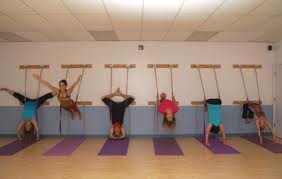
Upon entering the Yoga Haven2 studio in Scarsdale, NY, you will undoubtedly notice the wall of ropes hanging from loops along one side of the studio.  Beginning yogis, unfamiliar with yoga, might feel a little apprehensive:  "Will they be tying me up to the wall in this class?"  On the other hand, those who are a little more familiar with yoga become intrigued by the possibility of practicing with the mythical "ropes".

Just one of many props invented by B.K.S. Iyengar to improve alignment and support your asana practice, the ropes can bring your practice to a fun, new level.  Anyone who has ever sat on a swing and enjoyed the almost weightlessness or swaying back and forth, being suspended from above can appreciate the fun you have when practicing yoga with ropes.  As soon as I saw YH2 was offering a "Ropes Workshop", I signed right up!

The workshop was led by Jill, who, in addition to being a well-established Iyengar teacher, was also the instructor for the History and Philosophy portion of our teacher training.  She is a serious student of Sanskrit, and quite skilled in chanting - at least far more skilled than I can ever hope to be - various mantras and the Yoga Sutras of Patanjali.  She is also rather well-known for being extremely precise in her instruction.  This is typical for Iyengar teachers (Erich Schiffman recounts being cuffed on the chin by Iyengar himself during practice for not keeping his chin precisely level during a pose), but for the yoga student who is less humble, this precision can be frustrating.

Jill began the workshop by reminding us to practice Ahimsa (non-violence/non-harming), Svadhyaya (self-study), and Tapas (discipline) while doing our work.  This was not a "yoga class", so there were no warm ups, no savasana, just 2 1/2 hours of perfecting postures, feeling the difference with ropes and without.  This was the chance to study our practice and notice how the ropes support our work in the postures, and perhaps encourage more perfect alignment.  We needed to know our limits and not work past our edge, avoiding injury (non-harming).  We also should approach the practice with discipline, at least giving everything a try, no matter how impossible or acrobatic it looks. (Who am I kidding? This was a level 2 class, and everyone in there was after the acrobatics!)

We were able to experience subtle variations on postures, and perhaps work smaller muscle groups that we might not normally have access to without the ropes.  For instance, in a simple Adho Mukha Svanasana, we push down equally with our palms and balls of our feet to lift our hips into the "inverted V" shape.  With these props, your hips are lifted by the ropes, so a different group of muscles in the upper arm are isolated and worked.  With regular ropes work, I can envision it making a real difference in the sculpting of the arm.  Trouble is, workshops like these don't come around often, and when they do, they are a little pricey ($45 would be hard to cough up every week).

By the end of the 2 1/2 hours, my hands were sore.  I had a touch of rope-burn, and complained a little, to which Jill replied, "Oh, well, you're building strength in your hands, and when you're 80, you'll be able to open that jar of pickles on your own."  I also had done some wacky iterations of Warrior 1, Warrior 2, Wheel, and even Childs Pose with the assistance of the ropes.  The proverbial jewel in the crown was the final posture of the session, an inversion:  We did Sirsasana (headstand) on the ropes.  This is the pose you can see in the photo above, with the students' legs in a diamond shape, the ropes suspending them upside down from the wall.  It was great!  After the long workshop, it felt like no time at all had passed, and despite working my muscles for 2 hours solid, I wasn't tired.  I felt limber, invigorated, and ready to go throughout the rest of my day with a feeling of lightness and strength.  I guess that's what happens when you get to fly a little from the ropes!

"Yoga is the perfect opportunity to be curious about who you really are." - Jason Crandell

Friday, July 12, 2013

When is the best time to practice? (Part 2)

As alluded to in an earlier post (click here), yoga is not all about the Asana.  Yoga is a practice...something you do to connect with your inner self.  A yoga practice asks you to slow down and notice.  This is fairly difficult for many of us who are pre-programmed to be "busy" all the time.

Yes, I am one of those people who has a hard time just sitting.  There's always something to do, some chore to complete, some place to be, some person to assist with some task or another.  I find that yoga is good for me because it forces me to stop "doing" and just start "being"...but just sitting there will make me feel like I'm about to jump out of my skin, so the asana (moving my body into and out of specific postures) helps focus my attention on the present moment.  For someone who is somewhat proficient at multi-tasking, when I start moving on the mat, it requires my undivided attention to keep these ol' bones from falling.  I am forced to focus exclusively on balancing myself, moving gracefully, living solely in the present.  This is common with a lot of people, so it's worthwhile exploring when the best time is to practice ASANA.

You can "practice" yoga at any time, but depending on the time of day, you might need to make a decision about which type of Asana is best...but this of course, depends on your body, your mood, and your level of experience.  For example, upon waking, many people feel stiff and wouldn't even think about hopping right onto the mat for a sun salutation (or two).  Other people notice the stiffness, and think a few rounds of sun sals will work it right out and get the juices flowing.  The morning is a good time to slowly warm up - perhaps doing more warm-up poses than typical and gradually progressing to a few standing poses to build some strength for your day.  The afternoon, when most people are already well into their day, and energy levels are up, might be a good time for a more vigorous asana practice; something with more vinyasas and a little hopping and/or jumping (although I must say that an early morning practice never stops Kate from throwing some hops and jumps at us!).  The evening is when the majority of people are winding down for the day.  I know there are a few night owls out there, and they want a peppy pm practice to get their energy levels up for a long night, but I'm not one of those kinda birds!  An evening practice can be more restorative and gentle, with perhaps more of a cool down and longer savasana than is typical.

The take-away is that it really is up to you  - or should I say your body, because ultimately, the flesh and bones are what Asana is about.  It's important to honor the limitations (and requests!) of your body when choosing the type of yoga practice that best suits you.  If a practice is too vigorous for you in the middle of the day, your body will let you know - open your mind to listen to it.  If your limbs are up for more of a work out in the morning, go for it.  A yoga practice is about SO many things, including finding your edge, and know that there is no perfect time or place to do yoga, other than the present.

Thursday, July 11, 2013

An Apprenticeship

When you want to become a classroom teacher, you quickly realize that it is a fairly involved process.  There's the History and Philosophy of Education, there's Best Practices with which you should become familiar, and there's even the "anatomy of a school" - how administration is organized within the district, the school, the department, and even down to your classroom.  There are also endless hours of observation that you undertake, carefully learning under the guidance of a "master teacher" - or at least one who, hopefully, has been teaching for a good number of years.  Finally, you enter your "student teaching" phase - one where the master teacher hands over the proverbial "reigns" to a class or two - allowing you to craft a lesson, execute it, and with the teacher's help, assess how everything went.

In the yoga teacher training program, we hit upon every bit of these aspects of a traditional classroom teacher training, except one.  We learned the history and philosophy of yoga, we learned to dissect the foundational postures of yoga, and we learned the anatomy of the human body.  We read, we practiced, and we observed.  We wrote up lessons, we demoed lessons, and we took tests.  What we didn't do was "student teach".  Is this a necessary component?  Perhaps it might be.

Student teaching is a valuable part of a classroom teacher's training.  It allows you to craft lessons and execute them, but if something isn't quite right or needs adjustment, your cooperating teacher is right there to help you out of a jam.  There might be situations that arise where you are unsure of protocol or how to handle them.  Having that experienced teacher there with you, as another pair of eyes, ears, and sometimes hands, can lend a security to your lesson delivery.  "Master" teachers know how to think on their feet, they know how to quickly shift gears and guide a lesson to meet the needs of their students - and this is something that is gained only with experience.

This ability to "read the room", "problem solve", and "go with the flow" can't be taught in a classroom - it is learned on the job, and it's so much easier to pick up when you're an "apprentice" rather than a newbie tossed into a situation.  For this reason, I think a "student teaching" of sorts might be a valuable part of a yoga teacher training, especially when you have such a varied background of experience, body-type, and ability in a yoga classroom.

Luckily, I've found a "seasoned", heck, I'll even say "Master" yoga teacher to apprentice under.  I'm so grateful for the opportunity - not because I'm too chicken to undertake my first yoga class on my own.  I'm honored that another teacher is willing to share her craft with me, letting me learn the subtleties and nuances of a class while she's there as "backup".  She can help me dissect my lessons and help direct them in a positive way, simply because she's likely seen it before and been in that situation.  Truthfully, I think apprenticing is a good way to gain positive teaching experiences and help me to become a better-rounded teacher.

So, for those of you who are local, I'll be beginning my Apprenticeship at Prasanthi Studio, 136 Fifth Avenue in Pelham this Saturday - teaching a Yoga Foundations: Beginner Series, from 11am to 12.  Hope to see you on this next part of my yoga teaching journey!

Namaste.

Wednesday, June 19, 2013

When is the best time to practice? (Part 1)

Establishing a regular yoga practice can be rather challenging for anyone...and not just for people who are new to yoga, although they are overwhelmed with the postures, the language, the philosophy and the history behind the practice of yoga.  Even "seasoned" yogis can have a hard time committing to a practice.  I recognize that I am in a very busy time of the year in my regular career (why must the end of the school year always be so crazy?!?), but I am finding it unusually difficult to get myself onto my mat.  There is the time factor, and there's also the motivation factor (who has energy at the end of a dizzyingly busy day - and who has the energy to squeeze in a practice before you get to work?).

It's the ultimate irony that when you need yoga the most, it seems so elusive!  You begin to fall into a pattern:  "well, I didn't get to it this week, but next week will be less busy, so I'll get to it then".  These patterns don't help - they ultimately become patterns of avoidance, and the time between yoga sessions will get longer and longer.  The stress will be building and building, and the insecurities will set in: "It's been so long since I've practiced.  I just don't know if I'll remember how to do anything..."

The beauty of yoga is that you can do it at anytime.  All that's required is a little mindfulness.  Most people forget that yoga is not just the asana postures you see above.  Asana is just one eighth of "YOGA", and even that can be done anywhere - it doesn't require a mat or acrobatics.  Solely limiting yourself to asana is limiting your yoga practice.  Once you open yourself to the realization that yoga is not a physical exercise, not just a "workout", you can see that it's a body-mind-spirit experience, and you can do it at any time.

If you're like most people, you tend to focus on asana, so we can start there in my next post ("When is the best time to practice?  Part 2"), but keep your mind open to the possibility that just sitting quietly for thirty seconds and listening to the sounds around you while you focus on your breath is "yoga".  I can almost guarantee that you will feel more calm and focused, perhaps even energized for the next item on your agenda.  Thirty seconds, that's it.  Try it right now... slide your hand off of the mouse, hold your hands in your lap, and just breathe.  If your mind is so fidgety, bring your attention to your breath by counting how many breaths you take during those thirty seconds - that's a start, and it's a start to your yoga practice.

Did it work?  Do you feel a little more calm?  Thirty seconds is all it took...Next time you can expand your practice to 45 seconds.  You can even do that while you're waiting at the next traffic light!

Namaste.

Friday, June 14, 2013

As I was driving to a yoga class this morning, I passed my time on the highway by thinking about how busy I have been and how long it has been since I blogged.  I knew it was (finally) Friday, and I knew that I have been crazy busy all week, but it dawned on me that if I tried to explain to someone just *how* busy it has been, I couldn't remember a single thing I have done all week!  I would have to pull out my phone, look at my calendar, and then recount how I had some bit of busy-ness every single day (and how nerdy would that be?).  I have just been living day-to-day, focusing on the day's tasks, responsibilities, and events, not trying to think too hard about what the next day would hold.  True "yogic" philosophy - be here now, endure the present, live in the moment.  But because I wasn't doing this fully, I couldn't remember where I had been.  I woke up on Monday morning, knowing it would be a busy week, and now, here I was, on my way to a 6am yoga class on Friday.  And it's still not done.  Saturday has me involved in 5 different things.  I actually have it planned into my calendar for tonight that I have to "plan Saturday".

Why does life get like this?  And can yoga help?  Simply put, "I don't really know why" and "Thankfully, YES."  Maybe life gets busy because we have a hard time saying "no".  Some people have a hard time sitting still and "being".  We like "doing".  But Diann used to remind us frequently that we are "Human Beings", not "Humans Doing".  This morning, I brought myself to the mat because I so rarely get to practice with Marguerite, and I made a commitment to myself last Saturday that I would make it to her 6am Friday class.  Once I got there, I realized how very much I needed to be there.  Marguerite built her class to work us up to crow pose (Bakasana) - a flying posture, but the class began with a sequence to center us, to bring us to the practice, and it was during this time I figured out that I really needed to be grounded for a little while.  I've been flying around for the last 5 days, and I hadn't fully appreciated some of the wonderful things I was a part of.

Now, the class did get us up off our tushes and into some standing postures, and true to her promise, Marguerite got us to fly into crow by the end.  What I can take away is that yoga helps us in these whirlwind times by just slowing the pace down and allowing us to bring our full attention to the task at hand.  We build the strength that will carry us on to the next task and we cultivate the patience necessary to "juggle".  Plus, we get to have a little fun along the way, as we fly like birds into some of the postures.  By Savasana, we get the chance to re-center our spirits, absorbing the benefits of the practice, and perhaps reflecting on how the experience on the mat made us feel different than we felt at the start of practice.  Hopefully, a sense of relaxed confidence will carry us along for the rest of the day - or at least for the drive back home after class.

It's okay to stop once in a while and breathe.  I just have to get through this weekend, and I can start "being" again.  It will be a welcome respite!

The rhythm of life is when you experience your own body, mind, and soul.

Saturday, May 25, 2013

CYT vs. RYT?

Yep, that's me.  RYT-200, a card-carrying "Registered Yoga Teacher"!  I got my card in the mail from the Yoga Alliance last Wednesday.  Considering that I have spent every Wednesday since September spending time on my mat in yoga school, it was only fitting that I received my card on a Wednesday.

But what does RYT mean?  Is it any better than CYT (which was the distinction I earned on May 8th)?  CYT means "Certified Yoga Teacher", and can be bestowed by a yoga school upon someone who has completed a training with that school.  The difficult thing, is that in the Western Hemisphere, teaching Yoga is a relatively new discipline, and as of yet, there is no legal regulation on what level of training is necessary for teaching yoga.  Basically, you can attend a 2-hour workshop, and receive a certificate saying you attended said workshop, and you can say you are "certified".  Obviously, this is not on-par with someone who has completed a 200 hour teacher training (such as the one my colleagues and I completed), and luckily, most yoga schools have rigorous 200 hour trainings.  Anyone who has spent 200 hours in training to do something should be fairly competent at it, so a CYT usually holds a fair bit of gravitas.

That said, it's worthwhile to point out that the 200 hours can comprise just about anything - perhaps it's 200 hours of chanting.  Or 190 hours of anatomy and 5 hours of asana and 5 hours of breathwork.  In order to be truly proficient, you need to have a good balance of History and Philosophy, Asana work, Breathwork, how to do modifications, know the difference between Pre-natal yoga and Restorative yoga, and more.  A Quality 200 hour program will offer that, but how do you know a program "measures up"?  That's where the Yoga Alliance comes in.

It is highly controversial, because yoga is a discipline that is hundreds, no, THOUSANDS of years old, and here we are, in the West, with our exposure to yoga in its infancy, creating an "alliance", trying to impose "regulations" and "certifications" on the practice of yoga.  However, as is the case with anything that becomes wildly popular, there is the tendency for people to "cut corners" and generate "knock offs" in an effort to meet demand.  The Yoga Alliance wanted to preserve the integrity of yoga teaching, and ensure that schools who were training yogis had a good balance of instruction; basically, the Yoga Alliance wants to make sure that people who were claiming to be yoga teachers really knew their stuff.  People who have been teaching for decades and DO know their stuff are among the biggest opponents of "the Alliance", as they may not have the CYT from an official school, but they do have years and years of practice under gurus and service in ashrams to their credit.  To an experienced yogi, those sorts of "qualifications" actually garner more respect than any certificate, no matter how many seals and curliques on it.  But for people who are newer to yoga, the RYT designation provides a sort of assurance that your yoga teacher knows his/her stuff.

I am a middle school teacher by day, and as a state employee, there were rigorous certification requirements for me to complete in order to hold a job in New York State.  At the end of my graduate schooling (I went to school in Boston) and administrative evaluations and student teaching, I was certified to teach. In Massachusetts.  In order to teach in NY, I had to go through it all again (except the schooling!).  Once I got my NYS certification, I knew I could pass muster with any public school in the state, and any hiring district knew that I met the minimum standard (once I began teaching, of course they realized that I EXCEEDED the minimum standard!).  With such importance of recognized certification in my day job, I felt it was just as important to seek a nationally recognized certification for yoga teaching, as well.  Being a RYT provides a level of competency for my students, an assurance that the teacher training I went through was "the real deal".  Besides, I'd already spent 200+ hours (my program also required us to be a student in 52 yoga classes, which were not part of the 200 classroom hours) and thousands of dollars earning my certification, so what was another $85 to get my RYT?

So, I'm Certified, I'm Registered, you can look me up in the Yoga Alliance directory, and find the link to my blog.  I'm "official"...now I have to start finding a place to teach!  Stay tuned...

Monday, May 6, 2013

One door closes, another opens

 So, this picture could have easily been me last Wednesday as I was sitting in the yoga studio with 17 of my cohort, frantically scribbling our answers to the written final exam.  We studied our Sanskrit, we memorized our sutras, we learned our anatomy, we freaked out a bit, panicked a lot, but it's over.

Today, we sit on eggshells, awaiting the results of, arguably, the hardest exam I've taken in recent memory.  That said, I don't regularly take exams (I'm usually administering them to my 8th graders!), but I think this was certainly challenging.  Is it because my brain is a bit older than it was the last time I had to take an exam?  Is it because the test was such different subject matter than what I do on a daily basis?  Who cares!  It was hard, and I know for sure that I didn't get a 100.  And I'm not done.  I still have my final Test Class to give this Wednesday.  I have been practicing this class with friends in my living room, colleagues at work, and reciting it to my kids at breakfast.  It's just 30 minutes, and on Wednesday night, I'll be teaching it to 6 students in an effort to *finally* finish the requirements for my Yoga Teacher Certification!  I'm a nervous wreck.

Why am I so nervous?  This is something I've been preparing to do for the last 8 1/2 months.  That's almost as long as a pregnancy, and I've done that twice!  I wasn't one bit nervous about giving birth.  I knew it was something I wanted very badly, and I knew it was something I was born to do.  I also knew that it was something where it was expected I would make mistakes, need to be forgiven, and sometimes need to "do over" (eg, that first diaper change...).  If becoming a mother didn't freak me out so much, then why is becoming a yoga teacher freaking me out so much?

I love doing yoga, I love learning about it, I love what it has made me, and when I think about sharing that with yoga students of my own, I feel so hopeful and excited!  I somehow still have cold feet about starting this.  And yes, I do mean "starting", for the teacher training is drawing to a close, but another door is opening.  I'm a bit intimidated by what I might find past that open door, and I'm approaching it with trepidation.

I have been through a lot in this training, I've learned things I never could have imagined learning, my perspective has changed on a lot of things, and I've met some really incredible women - friends I never would have made otherwise.  We are almost like a sorority, forever bound by this common experience.  I am not "besties" with everyone, but I still share a bond with them that I will value and treasure for a long time.  We've become comfortable, safe, and secure in our Wednesday night environment, and now that's all about to change.  We have to get out there and put our theory into practice; we have to get out there and do it.

I have many friends who have helped me along the way, with a kind word of encouragement, with a vote of confidence, with some time on the mat, or a glass of wine, and I am so eternally grateful for that friendship.  In addition to that, I am eternally grateful for and feel blessed by the friendship and fellowship of my cohort sisters, as well.  I truly couldn't have accomplished this without them.  Each week they were faithfully there, learning alongside me, and not knowing me prior to this training, still offering encouragement, support, and yes, even a vegan cookie or a glass of wine!  So, as one door closes, another opens as we take the next step forward on our journey. I hope our journeys' paths stay nearby so we can visit once in a while.  Thank you, Wendy, Debbie, Lisa, Charlotte, Danielle, Michelyn, Connie, Jana, Nan, Nancy, Elena, Susie, Sue, Jillian, Dawn, Terri, Jennifer, Hannah and Allie!  I would be honored to take your class anytime.  Namaste.

Tuesday, April 16, 2013

Doing your Dharma

There is a wonderful "Yoga Wisdom" article in the May issue of Yoga Journal about how yoga can help with job satisfaction. The article, by Sally Kempton, explains how the teachings in the Bhagavad Gita can help you make sense of the ups and downs of the workplace.  Since we have been reading and studying (and trying to make sense of) the Gita during teacher training, I found the article particularly interesting.

As a Middle School science teacher on the cusp of two very busy, full weeks of State Assessments in Math and English, the article was also quite timely.  The main point of the article is how yoga can help you love your job, and it goes beyond figuring out whether you "Live to work, or work to live".  It's more about finding out what your "Dharma" is; your duty - but "duty" in the sense that there is one job that you alone excel at  - and that is the one job that will bring you happiness if you fully engage in it.

This begs the question, "Is my current job in-line with my Dharma?"  Many of us, in this economy, feel lucky to have a job at all, and don't necessarily feel like we are in a position to start questioning whether we are cut out for the job we're doing.  The Bhagavad Gita suggests that if you aren't happy, then you probably aren't cut out for your job, no matter how much material success it brings.  This is a hard pill for people to swallow, Americans, in particular, who build their careers on the promise of hard word equating with great reward and success.  Financial matters are a large part of this puzzle, but not the only piece.

In my line of work, our merit is increasingly determined by "results" - this is not a foreign concept to most people in the work force.  However, the "results" in education are judged by standardized tests - THIS is a foreign concept when for the last 16 years, educational research shows that there is no such thing as a "standarized" student.  Regardless, instead of creating inspiring lessons that help kids to become independent questioners, thinkers, and innovative learners, a good deal of time must be spent on preparing for the standardized tests.

Testing generates a lot of stress among the students.  Each year there are new benchmarks that must be achieved - the bar is raised and educational freedoms are reduced.  The actual testing mode is basically a "lockdown", and teachers turn into warden-like proctors who are allowed to do little else than offer an encouraging pat on the back and make sure all the bubbles are filled on the answer sheets.  In turn, seeing his/her students in such distress creates a lot of stress for a teacher, and here is where the Gita attempts to curb the cortisol (cortisol is a hormone that is abundant in times of high stress).

2.47 says "You have a right to the work alone, not to its fruits".  This is a hard concept to come to terms with...especially when, like most people in the workforce, your performance is evaluated on and connected to the outcome.  However, the Gita encourages you to do your Dharma.  If you were cut out for this job/duty/role, the outcome will be just fine.  If it's not satisfactory, maybe you're doing the wrong Dharma.

This is much, much easier said than done, and few of us have the luxury of approaching outcomes and bottom lines with this sort of non-chalance.  However, in times of stress, at the 9th hour, when you know you've done everything you can, all the i's have been dotted and t's have been crossed, meditating on this verse in the Gita might, just might, let you surrender the stress and let go.  Afterall, isn't that what yoga is all about?

"Live simply, expect little, give much.  Fill your life with love, scatter sunshine.  Forget self.  Think of others and do as you would be done by." - author unknown (to me)

Friday, April 12, 2013

CD Review: Putumayo World Yoga

There are lots of things we fledgling yoga teachers talk about:  What to do if you're attracted to a student, Whose level one class is good, Whose level two class is killer, when can we find time for a study group for all that Sanskrit, whether or not we can handle Restorative yoga, and whether or not we like Iyengar (I happen to like it; more on that in another post).  One of the most pressing conversations, however, is finding good music to put on your "Yoga Teacher Playlist".
Yes, as a Yoga Teacher, you will need a playlist.  I have taken class with very few teachers who do NOT use music while teaching (and by "few", I mean Jill - who teaches Iyengar - is pretty much the only one who doesn't use music).  I think music is important for setting a proper mood for your class.  It all boils down to preference.  Some of the teachers I practice with use upbeat music, throwing in some contemporary tunes once in a while.  Others are bold enough to go full on pop (Diann frequently used Madonna - and she could get away with it!)  One of my colleagues in my cohort uses Bobby Ferrin and Maroon 5!  I love to sing along when I know the words, and I would probably get distracted with my instruction upon hearing familiar lyrics, so I knew that wouldn't work for me.  I enjoy it when my teachers use popular music, but when I'm doing the teaching, I need something that I'm not going to sing along to.
Enter Putumayo's World Yoga!  I found this CD while shopping at Whole Foods.  They have a whole rack/display of Putumayo's offerings, and over the years (months, really) I have purchased a CD or two from them.  My hubby is always dismayed when I pay full-retail for CDs, because iTunes is just so convenient (especially when you don't love ALL the tracks on a CD) - but for this one, the $14.99 purchase price was well worth it.  I am in love with this CD, and listen to it every chance I get.  In fact, I have used many of the tracks from this CD in the playlist for my "test class" (Yes, I have to prove that I am capable of teaching yoga by giving a test class - it's not unreasonable, but that doesn't make it any less stressful!)
Putumayo is a great company.The music arm of the company has been around since 1993, and they specialize in non-traditional music.  I have several of their CDs - including the original "Yoga" CD (which I don't like as well as this new release).  Their offerings are mostly compilations and I've not been disappointed with any thus far - although I admit I like some more than others.  In preparing for our vacation to Paris last year, I purchased the French Playground for the kids, along with the French Cd for grownups.  Both are great, and put you in the mood for baguettes, cheese, and fine wine.  In perusing their website, I see they have a "Vintage French" CD...guess which is next on my list of purchases! ;)
World Yoga is currently in heavy rotation around our house.  Favorite tracks include artist from Sweden, Uganda, Tibet, and North America.  The tunes range from soothing to upbeat to relaxing, and (key point!) many are in other languages, so I can't sing along, much as I'd like to.
I think if I don't sing along, I'll be sure to get more students in my classes, so this might be the selling point.
Buy World Yoga by Putumayo NOW.  You won't be sorry, whether a yogi, a civilian, or someone who just wants to chill.