Practice of Brahmacharya gives good health, inner strength, peace of mind and long life. It invigorates the mind and nerves. It helps to conserve physical and mental energy. It augments memory, will force and brain power. It bestows tremendous strength, vigour and vitality. Strength and fortitude are obtained... He who is established in Brahmacharya will have lustrous eyes, a sweet voice and a beautiful complexion. - Swami Sivananda
What a shame, Swami. A beautiful complexion, sweet voice, and lustrous eyes? And now that I'm looking good, I have to stay celibate...where is the justice in that?!?
I kid, I kid. Brahmacharya is important stuff for the yogi practicing Raja Yoga. Brahmacharya is the 4th moral restraint in Patanjali's 8-limbed path of yoga. It's sort of like an addendum to the plan. You've gotta follow these 8 limbs, but the first two limbs each have 5 parts/restraints/observances. You thought you were in for 8 paths, but really, there are 16 things you have to think about.
The idea behind Brahmacharya is not to engage in any activity that is purely for pleasure. Live in moderation - don't be lazy, don't engage in your bad habits, don't excessively eat or drink, and of course, don't waste your energy on sex. Basically, you're following these 8-limbs, and it's going to take all of your energy to do that with the proper devotion, so don't go wasting your energy on lustful things.
Brahmacharya used to be a proper life-stage, like adolescence; a time period where you were devoted to learning and studying with your guru, and you didn't have time for frivolous things like lust and excess. Not a bad plan; as an 8th grade teacher, I think that adolescents could benefit from enjoying some brahmacharya. Perhaps we'd have less "Teen Mom" and a lot more "Honor Roll Report Cards". Right? Somewhere along the way, this idea has gone by the wayside, and nowadays, celibacy seems to be practiced only by select, devout few.
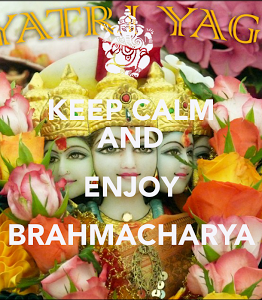
As far as I'm concerned, I think I am capable of keeping calm and enjoying Brahmacharya while I'm studying the 8-limbed path. It lends a bit of seriousness and authenticity to what I'm doing. I can always benefit from augmented memory, vigor and vitality. In this season of germ-infested clouds of viruses whirling around us, I probably need extra strength and fortitude. It can't hurt to give up some of life's little luxuries...It's only a week, right?
Tuesday, January 8, 2013
Thursday, January 3, 2013
Asteya
![]() |
| Whoops! I "stole" this image but here's the credit |
No, I'm not one of those suburban shoplifters; I'm not a cat burgler. I don't think up schemes to rob banks. If only Asteya were so simple! It's not just "Hey, don't steal stuff". The more I read about it, the more I realize just how deep it goes. And the deeper it goes, the more doo-doo I'm in.
Patanjali's sutra on Asteya says "To one established in Non-stealing, all wealth comes." This is commonly interpreted as "Do not take that which has not been offered to you". Common sense, right: "Don't steal". What is not immediately apparent is that Patanjali's not necessarily talking about worldly goods. It turns out, you can "steal" lots of stuff. You can steal time. Think about that the next time you're waiting in the doctor's office. You can steal safety - something to ponder the next time you drive recklessly. You can steal space - haven't you ever taken up a bit too much room on the subway, or spaced out a bit in the movie theater?
These seem like rather "innocent" forms of stealing, but when I really consider them, it makes me think that I really do not have the right to steal the safety of others, I shouldn't keep people waiting, or take up more space than I need. But THEN, when I talk about taking up "space" that I don't need...what about taking up "stuff" that I don't need? This would include buying things that I don't need. I
Oh boy, this is going to be quite a journey.
"No one is ever really taught by another; each of us has to teach himself. The external teacher offers only the suggestion, which arouses the internal teacher, who helps us to understand things." - Swami Vivekananda
Tuesday, January 1, 2013
Welcome to 2013!
![]() |
| Hangover, anyone? |
Alex is a well-regarded teacher at my studio, and today was my first class with him. As I entered the studio, he greeted a familiar face, inquiring after her New Year's celebration and asked jovially if she had a hangover. She said, "No...", but I threw it out there that I sure did! He just smiled and said "Oh, really?", but got caught up in another conversation. I unrolled my mat, and Alex started to clue into the fact that it would be a packed class, so he asked us to move our mats closer, "like only leave a foot or so between the mats". He also made sure to walk around before class and introduce himself to the students whom he didn't know, myself included (this is a good practice for a yoga teacher to establish if there is time before class - you can check in with your students and find out their experience level, if there are injuries or limitations, etc). We shook hands, and Alex asked me if I really did have a hangover, to which I replied, "Yes, I really do. We haven't met before, and I wish we were meeting under better circumstances!" He smiled, and advised that I would feel it in down dog and any inversions, and I countered that if I fell over, he would understand why!
I was right up front. Seriously, right in front of the guy. With every exhale, I was paranoid that I was spewing forth champagne-laced hangover breath right into his face. Space was tight, and with every sun breath, I was smacking the gal next to me if I didn't watch my arms. But I didn't fall, and with every breath, I was able to inhale more and more fresh air. When I felt dizzy, I closed my eyes and took deep, cleansing breaths - I surely needed them! Towards the end of the peak poses, he coaxed us into a half-moon, and I was so proud of myself that I was able to hoist myself up there without falling over.
I made it through the practice, and really did my best to bring my A-game. I was attentive to alignment, attentive to breath, took variations when I needed them, and when he offered headstand at the end of practice, I wisely chose to do legs up the wall. I didn't make any new year's resolutions last night, but if I'm attending yoga classes with a hangover, perhaps I should have. I survived, but I think my experience would have been even better and my time on the mat a little more focused if were not so worried about my stinking exhales. What does matter is the fact that I practiced today with gratitude and did my best to practice with grace, and I will continue both of these practices well into the future. Without a hangover.
I liked what Alex said to us when we were in Warrior 2 with the left foot forward: "Your right hand is in the past, your left hand is the future. Gaze into the future, have the courage to be here in the present."
Monday, December 31, 2012
Mudras
![]() |
| It's okay. It's Jnana mudra! |
I have also been caught practicing a Yama or two lately (ha ha....I'm observing one per week), in between learning about the chakras, some anatomy, and thinking about creating class outlines. My brain has been scattered all over the Yoga "Map", as it seems, and I don't think my asana has been as "spot-on" as it usually is. Perhaps studying the proper alignment for postures has made my foundation a little less confident, perhaps I've just been too tired to focus on my poses, perhaps I've had a bit too much wine this holiday season (ahem. maybe I should just go with the last one and call it a day). Whatever the reason, I've felt the need to find something to help me ground my practice and get the poses bit more on target. I've found that Mudras can help!
Mudra is a Sanskrit word that means "seal", and mudras are simple hand gestures that convey messages or a focus within your practice (no, I'm not talking about THOSE types of hand gestures!). As part of our teacher training, we are expected to know ONE mudra. I know that "one" doesn't seem like a whole lot, but there's a lot of other stuff we need to know, including entire phrases in Sanskrit, so cut us some slack. Mudras are often visible in Hindu statues and icons, and the position of the statue's hands convey great meaning.
Anjali mudra (hands held in prayer with thumbs resting together on the sternum/breastbone) is commonly used during practice, so I already "know" a mudra, but me being me, I'd like to know more than one. Some mudras are quite challenging to form with the fingers. I personally have a hard time with Vishnu mudra, where the first and middle fingers bend forward, while the ring and pinkie fingers remain flexed and the thumb rests alongside the fist. Basically, I can't straighten my ring finger in this position; it's really uncomfortable for me. One mudra that I have come to appreciate, however, is Jnana mudra, or as people in the western hemisphere might say, "the OK sign!". This is a simple and comfortable mudra, but it also has a wonderful meaning for your yoga practice.
The Jnana mudra is often seen when a figure is sitting in a comfortable cross-legged position, and the hands are making the "OK sign" with the backs of the hands resting easily on the knees. Each finger has a meaning, and the position of the fingers has a great deal of symbolism for this mudra (and your yoga practice). The thumb represents the energy of the universe, and the index finger represents your true "Self". By bringing your thumb and index finger to touch, you are bringing together your self with the universe, effectively uniting them (the ultimate expression of Raja yoga). The remaining three fingers represent the "Ego" (middle finger - rather telling, don't you think, when flipping someone the bird?), the "Mind" (ring finger), and "Worldly goods" (the pinkie). By opening these fingers and resting the hands on the knees, we allow these aspects of ourselves to drip away from our practice, to drip away from our true selves and the energy of the universe. No one needs an ego on the mat, you can forget about the mind because your body will guide you - you just have to listen to it!, and worldly goods are of no use to you when you're practicing asana.
So, as 2013 approaches, with it's first 4 months filled with "yoga everything" for me, Jnana mudra will be a wonderful symbol to come back to. I can allow it to guide my teacher training - I'll find the energy to finish, I'll let my ego get out of the way, I'll try to forget about worldly goods (I really DO have plenty), and I've already lost my mind, so I won't miss it!
Happy New Year! May 2013 find you joyfully on your mat! Thanks for reading! - Megan
Wednesday, December 26, 2012
Satya
Perhaps an example will clarify. Last week, I was practicing Ahimsa, or non-harming, which sort of means following a vegan diet (you know, non-harming the animals and all). I wasn't strict about the veganism (hey, I'm being truthful!), but I did observe a vegetarian diet for the week. In fact, until Christmas eve's Feast of the Seven Fishes, I was doing okay, but, I was technically on to Satya by that time, so eating a bit of meat wasn't the end of the world. At said Feast, my friend's mother in law mentioned that they "don't ever eat meat on Christmas eve" as she tucked into the very, very delicious seafood salad. I did my very best to bite my tongue and not mention that, "Uhm, that seafood salad you're heaping on your plate is loaded with meat..." I wasn't being untruthful - she knew what she was doing...I just didn't want to mince words over her definition of "meat" versus mine (and the rest of the known universe). Earlier in the week, I made vegetarian chili using "Quorn" (a mushroom-based meat substitute, and quite delicious), and I urged my children to eat their "meat". I also made a "BLT" using smoky-maple flavored tempeh. I gave half to my husband and told him it was a BLT. He wasn't fooled, and even enjoyed it, but I didn't give up the gig until after he'd had a bite and inquired, "Uhm, where's the bacon?"
So what is truth? Is it conditional? Are there degrees of truthfulness? Are there times when it's appropriate to be untruthful? I'm going to propose "Yes" to all three, even if I may be betraying the intent of Patanjali. If I never experience Samadhi, I'll know it could be because of my lack of truth.
As I ponder my willingness to say it's conditional, it comes in degrees, and there are times when it's appropriate to be untruthful, it begs me to ask: Is it okay to be untruthful as long as "no one gets hurt"?
On Christmas eve, I think it was appropriate to bite my tongue about the seafood not being "meat. The mood was merry and bright, and if I brought up the fact that my friend's MIL was wrong, it would have made her feel defensive, put a cloud over her meal (and probably everyone else's), and after all, it isn't the end of the world that she thought seafood wasn't meat. This way, everyone stayed happy, unharmed. If I had brought up the truth, not only would I have been perceived as being obnoxious (which I'd like to think is NOT my true nature!), I am sure that more than a few people would have been unhappy.
Now, I'm not going to go around, living my life, wondering if in each situation it's okay to get away with a lie or being untruthful. Like I said before, I'm not in the habit of lying for lying's sake. What I am saying is that in certain situations, a lie may not be the worst thing. Am I "lying, with love"? I think we have all experienced that. When an acquaintance asks your opinion, sometimes it's easier to be complimentary rather than truthful. When you're trying to get your kids (and husband!) to eat healthier, a little untruthfulness may not be the worst thing. I can justify this as a version of the truth that equals love. Can't I?
This above all; to thine own self be true.
And it must follow, as the night the day,
Thou canst not then be false to any man - W.Shakespeare, Hamlet Act 1, scene 3
Monday, December 17, 2012
Ahimsa (part deux)
Kiss with a Fist
So Florence claims that the tune is not about domestic violence...but rather about people in love who push one another to psychological extremes. Well, Ahimsa actually speaks more to that than actual kicking, slapping, stomping, smashing violence, I think.
Either way, it's a great song. Too bad I shouldn't be aurally indulging myself with it for a week.
Ahimsa pratisthayam tat samnidhau vaira tyagah (in the presence of one firmly established in non-violence, all hostilities cease.) - Patanjali's Yoga Sutras 2.35
Monday, December 3, 2012
Facing the Octopus
Patanjali "wrote the book on Yoga". Let me clarify: Patanjali was not the first guy to write about Yoga - he certainly was not the last - he writes that he is merely "continuing the teachings of yoga", teachings that have been around for centuries millenia. In fact, most yogic scholars aren't even sure that Patanjali was one person; they believe Patanjali is the nom de plume of a collection of authors on the subject of what yoga is. Nonetheless, "Patanjali's" Yoga Sutras are the go-to texts for serious students of yoga, and it features heavily on our reading list for teacher training.
Patanjali was a proponent of Raja (or Royal) Yoga - and developed "Ashtanga", or an 8-limbed path one must follow in order to practice Raja Yoga. *I particularly like the image I found for Patanjali - a many-snake-headed figure...perhaps alluding to the many authors contributing to the Sutras? Perhaps symbolizing the main idea of the Sutras - the 8-limbed path known as Ashtanga. In reality, he is associated with being lord of serpents (the many heads mean "omnipresence"...you can read more about Patanjali here). Either way, this path is something to be reckoned with, and we need to "reckon" with it for the next 2 months.
The 8 paths are as follows: Yamas, Niyamas, Asana, Pranayama, Pratyahara, Dharana, Dhyana, & Samadhi. The first 5 limbs are to be practiced and worked-on simultaneously as you approach the last 3 limbs, which are attained sequentially. One must first practice Dharana (concentration) to reach Dhyana (meditations) and ultimately achieve Samadhi (union with the universe, complete understanding of peace, love, truth, etc).
Most people are familiar with Asana (the yoga postures) and Pranayama (mindful breathing, control of the life force) from their time in a yoga class. Instructors of some classes even discuss Pratyahara (turning inward), when they encourage you to focus your attention on your own mat, your own practice. The Yamas and Niyamas - there are 5 of each - are relatively novel, which is surprising considering they are rather significant to the 8-limbed path!
In our teacher training, we will spend the next 10 weeks focusing on the Yamas and Niyamas, practicing them with intent. We will be demonstrating Dharana - concentrating - on one Yama or Niyama each week. The first 5 weeks will be spent on the Yamas. The next 5 weeks will be the Niyamas. By the end of the 10 weeks, we will for sure know the names and meanings of all the Yamas and Niyamas, but we will ultimately learn a lot more about ourselves in the process.
First up? the first Yama - Ahimsa, which I've written about before. It is attributed to "Non-violence". Considering we are in the throes of holiday season fever, this will be an apropos time to study some "non-violence." I'll keep you posted...
"Practice becomes firmly established when it has been cultivated uninterruptedly and with devotion over a prolonged period of time" - Patanjali's Yoga Sutras I.14
Patanjali was a proponent of Raja (or Royal) Yoga - and developed "Ashtanga", or an 8-limbed path one must follow in order to practice Raja Yoga. *I particularly like the image I found for Patanjali - a many-snake-headed figure...perhaps alluding to the many authors contributing to the Sutras? Perhaps symbolizing the main idea of the Sutras - the 8-limbed path known as Ashtanga. In reality, he is associated with being lord of serpents (the many heads mean "omnipresence"...you can read more about Patanjali here). Either way, this path is something to be reckoned with, and we need to "reckon" with it for the next 2 months.
The 8 paths are as follows: Yamas, Niyamas, Asana, Pranayama, Pratyahara, Dharana, Dhyana, & Samadhi. The first 5 limbs are to be practiced and worked-on simultaneously as you approach the last 3 limbs, which are attained sequentially. One must first practice Dharana (concentration) to reach Dhyana (meditations) and ultimately achieve Samadhi (union with the universe, complete understanding of peace, love, truth, etc).
Most people are familiar with Asana (the yoga postures) and Pranayama (mindful breathing, control of the life force) from their time in a yoga class. Instructors of some classes even discuss Pratyahara (turning inward), when they encourage you to focus your attention on your own mat, your own practice. The Yamas and Niyamas - there are 5 of each - are relatively novel, which is surprising considering they are rather significant to the 8-limbed path!
In our teacher training, we will spend the next 10 weeks focusing on the Yamas and Niyamas, practicing them with intent. We will be demonstrating Dharana - concentrating - on one Yama or Niyama each week. The first 5 weeks will be spent on the Yamas. The next 5 weeks will be the Niyamas. By the end of the 10 weeks, we will for sure know the names and meanings of all the Yamas and Niyamas, but we will ultimately learn a lot more about ourselves in the process.
First up? the first Yama - Ahimsa, which I've written about before. It is attributed to "Non-violence". Considering we are in the throes of holiday season fever, this will be an apropos time to study some "non-violence." I'll keep you posted...
"Practice becomes firmly established when it has been cultivated uninterruptedly and with devotion over a prolonged period of time" - Patanjali's Yoga Sutras I.14
Subscribe to:
Posts (Atom)


